
Introduction
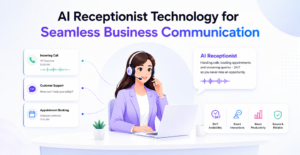
This is where AI Receptionist technology is transforming business communication. By combining artificial intelligence, automation, and advanced voice technologies, AI receptionists help organizations streamline customer interactions while improving service quality. These intelligent systems can answer calls, manage inquiries, schedule appointments, and provide support around the clock.
Modern solutions such as the AI Call Assistant and automated AI Phone Call management systems are helping businesses improve communication efficiency while reducing operational costs. Many AI Receptionist Reviews highlight how these technologies enhance customer experiences and create more productive workflows.
Understanding AI Receptionist Technology
How AI Receptionists Work
An AI receptionist is basically a virtual communication helper, powered by artificial intelligence and machine learning too , you know , in general
So when someone makes an AI phone call , the system listens, figures out what the caller wants to do , and then crafts replies that match what’s happening .AI receptionists can sound more natural, and they can keep a little context, even if it’s not always perfect , I mean I’m not gonna pretend
AI Call Assistant and Automated Voice Systems
The AI Call Assistant usually plays the main “brain” role inside a lot of AI communication platforms
It can handle things like :
Answering customer questions
Scheduling appointments
Managing reservations
Sending reminders
Running follow up communication
Sharing account details
Triage service requests
Automated voice systems help businesses take more calls while staffing stays the same . Customers get help right away , and organizations can keep service quality steadier instead of it swinging depending on who’s on shift , right then
Integration with Business Communication Platforms
Most current AI receptionist systems connect to the tools businesses already use
Common connections include :
CRM platforms
Scheduling software
Customer support systems
VoIP phone networks
Messaging applications
Core Technologies Behind AI Receptionists
Automatic Speech Recognition (ASR)
Automatic Speech Recognition, or ASR , helps AI systems turn spoken language into text
So it supports AI receptionists understanding conversations more clearly, and then replying in a way that fits the moment .
Machine Learning and Predictive Analytics
Machine learning helps AI receptionists improve over time, because the system adjusts based on conversation outcomes
Predictive analytics shows up too , so businesses can anticipate what customers might need, and handle issues earlier before they turn into bigger trouble
Cloud Based Communication Infrastructure
Cloud tech adds flexibility , plus scalability is what modern communication systems actually require.
Cloud based AI receptionist platforms usually bring benefits like :=
Remote access
Real time updates
Elastic scaling
Lower infrastructure costs
Better reliability
Key Features of AI Receptionist Systems
Automated Call Routing
An AI receptionist can interpret caller intent, and route calls automatically to the right department, representative , or specialist . This reduces unnecessary transfers, and it lowers customer frustration, because nobody gets passed around endlessly.
AI Phone Call Management
AI phone call management automates a bunch of communication tasks
Common examples include :
Appointment scheduling
Reservation confirmations
Service reminders
Customer notifications
Follow up calls
Information requests
The AI Call Assistant usually runs these tasks in a steady way, and it tends to stay accurate , which lowers admin load, and improves service reliability.
Multichannel and Multilingual Support
Many platforms also include multilingual support, so organizations can serve different customer groups more effectively .
How AI Receptionists Enable Seamless Communication
Automated Workflow and Task Management
AI receptionists streamline business operations by automating repetitive communication tasks.
Routine activities such as appointment scheduling, inquiry processing, ticket creation, and information collection can be handled automatically. This reduces manual effort while improving consistency and accuracy.
Personalized Customer Interactions
AI receptionists use customer data, communication history, and behavioral insights to tailor interactions to individual preferences and needs. Personalized conversations help businesses build stronger relationships and improve customer satisfaction.
Proactive Follow-Ups and Notifications
AI-powered communication systems can initiate interactions rather than simply respond to inquiries.
Businesses can automate:
- Appointment reminders
- Service updates
- Payment notifications
- Follow-up surveys
- Customer satisfaction requests
Benefits of AI Receptionists for Businesses
Enhanced Customer Experience
AI receptionists provide fast, reliable, and personalized support that meets modern customer expectations. Immediate responses and efficient service create positive impressions and strengthen customer relationships.
Increased Productivity and Efficiency
By managing routine communication tasks, AI receptionists free employees to focus on more complex responsibilities. Organizations can handle larger communication volumes without significantly increasing staffing requirements.
Scalability for Business Growth
AI receptionist systems can scale easily to accommodate larger customer bases and higher call volumes. Organizations can maintain service quality without proportional increases in operational costs.
Industry Applications of AI Receptionists
Banking and Financial Services
In banking and finance, AI receptionists handle account questions, appointment scheduling, transaction help ,and customer authentication too. Voice automation supports both security and service efficiency ,which is key when rules have to be followed ,and they generally do.
Healthcare and Medical Support
Healthcare organizations lean on AI receptionists for appointment scheduling ,patient reminders, inquiry management, and administrative assistance. Patients benefit because they can access info sooner, and healthcare providers get a little more breathing room on the operations side.
Retail and E-Commerce
AI receptionists can also manage seasonal demand shifts more smoothly ,instead of scrambling every time traffic spikes show up.
Telecommunications
Telecommunications providers deal with huge volumes of customer interactions. AI receptionists help with billing inquiries, technical support ,account management ,and service updates.
Travel and Hospitality
In travel and hospitality, AI receptionists assist with reservations ,booking confirmations, travel updates ,and guest support. Customers get immediate help during their journey, from before departure all the way to being on the ground ,and that usually raises satisfaction ,plus loyalty.
Challenges in Implementing AI Receptionist Technology
Accuracy and Language Limitations
Complex conversations, regional dialects, industry-specific terminology, and language variations may occasionally affect performance. Ongoing training and optimization are necessary to maintain high accuracy levels.
Customer and Employee Adoption
Some individuals may initially hesitate to trust AI-powered systems. Organizations should provide education, training, and transparent communication about the benefits of AI technology.
Future Trends in AI Receptionist Technology
Advanced Conversational AI
Future AI receptionists will engage in increasingly natural and sophisticated conversations.
Advancements in conversational AI will improve contextual understanding, enabling systems to handle more complex customer inquiries with greater accuracy.
Emotion Recognition in Voice Systems
Emotion recognition technology will significantly enhance AI communication capabilities.
By analyzing vocal tones and speech patterns, AI systems will identify emotions such as frustration, urgency, or satisfaction. Responses can then be adjusted to provide more empathetic support.
Human-AI Collaboration
The future of business communication lies in collaboration between AI systems and human employees.
AI receptionists will manage routine interactions while human representatives focus on complex situations requiring empathy, creativity, and critical thinking.
Hyper-Personalized Customer Communication
Future AI systems will leverage advanced analytics and customer data to deliver highly personalized interactions.
Customers will receive tailored recommendations, proactive assistance, and communication that reflects their unique preferences and needs.
Autonomous AI Communication Management Systems
Next-generation AI receptionist platforms will become increasingly autonomous.
These systems will manage entire communication workflows, conduct follow-ups, resolve routine issues, and coordinate customer interactions with minimal human oversight.
Conclusion
An AI receptionist is shifting business communication by providing support that feels smooth, intelligent, and scalable for customers.
With machine learning, automatic speech recognition, cloud infrastructure, and advanced automation, AI receptionists help organizations respond faster, carry more personal conversations , and run customer service more efficiently overall. Options such as the AI Call Assistant and automated AI phone call systems can raise productivity, increase customer satisfaction, and reduce the operational hassle too. And as a lot of AI Receptionist Reviews also point out, businesses that roll out AI powered communication often see real improvements in both efficiency and wider service quality overall.